**Updated May 2026** — This article reflects the Section 27 statutory guidance published on 15 April 2026, which formalises how capacity should be calculated (Supplementary Document A) and clarifies how the Act applies to shared spaces and multi-responsible-person scenarios. Commencement is now consistently being signalled as Spring 2027 (likely April 2027).
This article is part of our comprehensive guide to Martyn's Law. For an overview of the legislation, tier requirements, implementation timelines, and how AV technology can support compliance, see our complete guide to Martyn's Law.
Martyn's Law (the Terrorism (Protection of Premises) Act 2025) is designed to improve preparedness across UK venues and events. But who, exactly, falls under its scope? This post breaks down the capacity thresholds, venue types and exemptions so you can determine whether your organisation needs to take action — including the clarifications introduced by the April 2026 statutory guidance.
Capacity thresholds
The Act sets two capacity thresholds. Premises and events expecting 200 or more people at any one time are brought into scope. Those anticipating fewer than 200 people do not need to comply. Within the in‑scope category, there are two tiers:
Standard tier (200–799 people) – Venues and events with 200-799 attendees fall under the standard tier. They must take basic protective steps such as risk assessments, staff training, and notifying the Security Industry Authority (SIA) at (nalc.gov.uk). The focus is on low‑cost, proportionate measures.
Enhanced tier (800+ people) – Venues and events where 800 or more people may gather are subject to enhanced obligations (nalc.gov.uk). These include the standard requirements, plus further measures such as physical security systems (e.g., CCTV or bag searches), a designated senior individual to oversee compliance, and more detailed emergency planning (protectuk.police.uk).
For a detailed comparison of standard and enhanced tier requirements, see our guide: Standard vs. Enhanced Tier: What's the Difference?.
What counts toward capacity?
Capacity refers to the total number of people who could reasonably be expected on the premises at the same time, including staff, volunteers and attendees. It is not simply the building's maximum occupancy, but rather the actual number expected during events or peak times. Temporary events (concerts, festivals, fairs) count if the expected attendance meets the thresholds (insight-security.com).
**Capacity calculation under the April 2026 statutory guidance.** Supplementary Document A published alongside the main guidance formalises acceptable methods. Responsible persons may rely on fire safety safe-occupancy figures, historic attendance data or any other justified method, provided the reasonable-expectation test includes staff and volunteers as well as members of the public. Operators should document the method they used and the assumptions behind it, particularly where peak attendance varies across events.
Types of venues and events covered
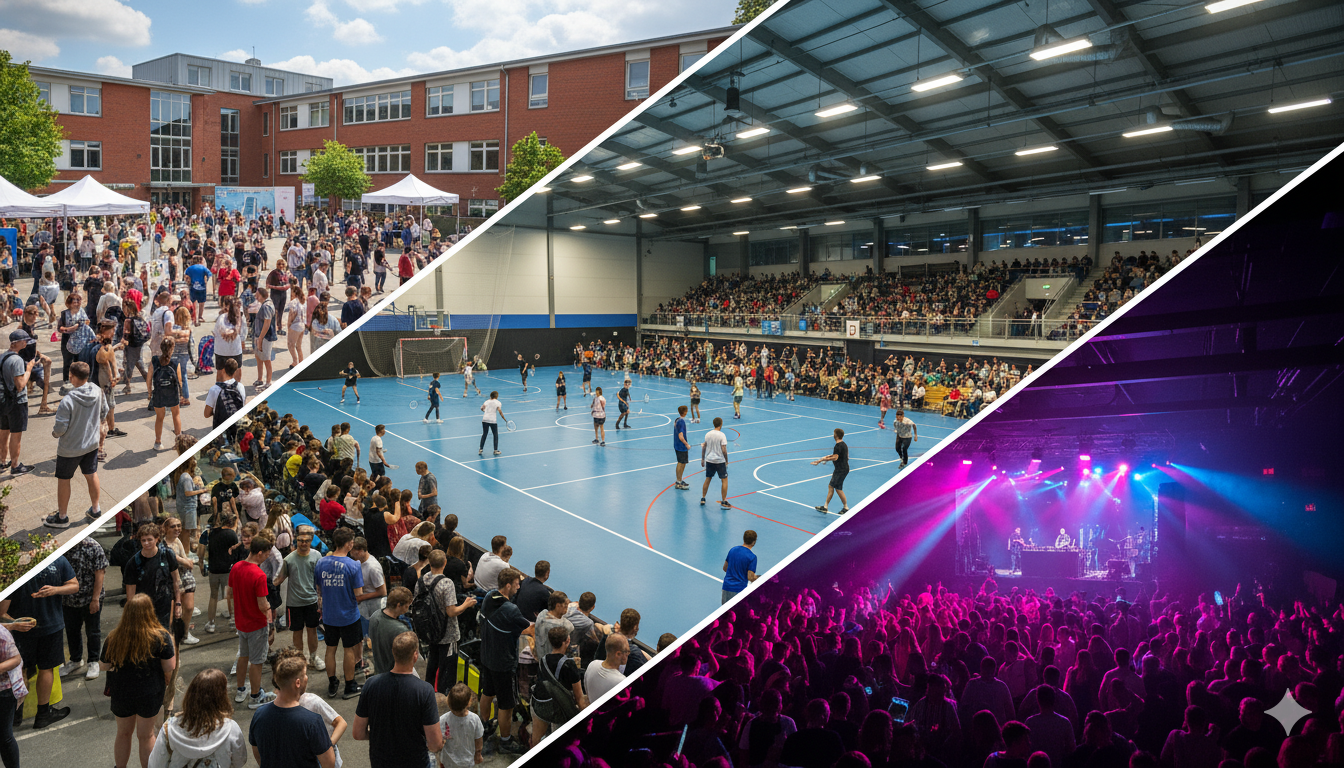
Martyn's Law applies broadly to publicly accessible premises and events, spaces where members of the public can gather, regardless of whether they are privately or publicly owned. Examples include:
Stadiums, arenas and theatres – large venues hosting sporting events, concerts or performances (insight-security.com).
Nightclubs and bars – entertainment venues where high footfall and crowded conditions necessitate preparedness (insight-security.com).
Shopping centres and retail hubs – complexes with multiple shops and food courts (insight-security.com).
Hotels and conference centres – venues hosting events, conferences and banquets.
Community spaces – including town and village halls, community centres, markets and fairs (nalc.gov.uk).
Parks and open‑air events – such as festivals, sports events and seasonal markets (nalc.gov.uk).
Sports and leisure facilities – playing fields, sports halls and public gyms (nalc.gov.uk).
Libraries and museums – publicly accessible cultural venues (nalc.gov.uk).
Public squares and landmarks – locations used for celebrations, vigils, or other gatherings (nalc.gov.uk).
Certain events are also covered, even if held on otherwise exempt premises. For example, a large festival hosted in a public park where capacity exceeds 800 people would fall under the enhanced tier because of the expected crowd size (protectuk.police.uk).
Exemptions and special cases
Not all premises are within scope. Parliamentary buildings and government administration premises are specifically excluded from the legislation (insight-security.com). There are also special considerations for education settings. Schools, colleges and universities remain in the standard tier even if more than 800 people are present (gov.uk), recognising the unique nature of educational environments. Additionally, events held in educational premises do not become enhanced‑tier events simply because they draw large crowds.
Private offices and workplaces that are not open to the public are generally outside the scope unless they host public events or have publicly accessible areas. Similarly, residential buildings are excluded.
Responsible persons
Every qualifying venue or event must have a responsible person, the individual or organisation in control of the premises for its principal use (insight-security.com). This person is accountable for conducting risk assessments, implementing security measures, training staff and liaising with the SIA. In multi‑use spaces (e.g., a church hired for a concert), the responsible person is whoever is in control of the specific event.
The April 2026 statutory guidance is explicit that statutory responsibility cannot be delegated. Where the responsible person is an organisation, a senior individual must be designated, and that individual is personally exposed to criminal liability of up to two years' imprisonment for breaches involving consent, connivance or neglect.
**Shared spaces and coordination.** The April 2026 guidance also spells out how multi-responsible-person scenarios work — shopping centres, transport hubs, high-street parades and other shared spaces where entrances, exits and public realm cross several controllers. Each responsible person retains their own duty, and there is an explicit coordination duty between them. Although coordination is not new in law, it is newly emphasised and likely to be a focus of early SIA enforcement.
Why identification matters
Understanding whether you fall under Martyn's Law is the first step toward compliance. Failing to meet the Act's requirements could lead to enforcement action or penalties once the Law comes into force. Even if you operate a smaller venue, taking proactive steps, such as simple risk assessments and staff training, can save lives in an emergency (protectuk.police.uk). For larger venues, preparing now for enhanced obligations will help spread out costs and integrate security measures into renovation or upgrade plans.
Next steps
Assess your venues and events: Compile a list of locations and events where 200 or more people may gather.
Assign a responsible person: Designate someone to oversee compliance for each venue or event.
Begin risk assessments: Even before detailed statutory guidance is released, start evaluating potential vulnerabilities and mitigation measures.
Explore technology solutions: Consider how digital signage, PA systems, CCTV and occupancy analytics can support security and emergency communication.
Read our Martyn's Law pillar page: For a comprehensive overview of the Act, differences between standard and enhanced tiers, and compliance timelines, see Martyn's Law: Complete Guide to the Terrorism (Protection of Premises) Act 2025.
Contact Strive AV: Our experts can help you assess your venues, recommend appropriate technologies and guide you through the compliance process.
By identifying whether Martyn's Law applies to your organisation and understanding the thresholds and venue types involved, you can take proactive steps to protect the public and ensure legal compliance.
Frequently Asked Questions
Q.What is the capacity threshold for Martyn's Law?
Martyn's Law applies to publicly accessible premises and events expecting 200 or more people at any one time. Venues expecting 200–799 people fall under the standard tier, while those expecting 800 or more people fall under the enhanced tier. Premises and events anticipating fewer than 200 people are not in scope.
Q.Are private offices and workplaces covered by Martyn's Law?
Private offices and workplaces that are not open to the public are generally outside the scope of Martyn's Law. The Act applies to publicly accessible premises where members of the public can gather. However, if an office hosts public events or has publicly accessible areas, those parts of the premises may fall in scope.
Q.Do schools, colleges and universities have to comply with Martyn's Law?
Yes, with special provisions. Educational settings such as schools, colleges and universities remain in the standard tier even if more than 800 people are present, recognising the unique nature of educational environments. Events held on educational premises do not become enhanced-tier events simply because they draw large crowds.
Q.What is a "responsible person" under Martyn's Law?
Every qualifying venue or event must have a responsible person — the individual or organisation in control of the premises for its principal use. This person is accountable for conducting risk assessments, implementing security measures, training staff and liaising with the Security Industry Authority (SIA). For multi-use spaces such as a church hired for a concert, the responsible person is whoever is in control of the specific event.
Q.When does Martyn's Law come into force?
Martyn's Law received Royal Assent on 3 April 2025. The Section 27 statutory guidance was published on 15 April 2026, and the Home Office, the SIA and most legal commentators are now consistently signalling Spring 2027 (likely April 2027) as the commencement date, subject to formal Parliamentary confirmation. The SIA's Section 12 enforcement consultation runs until 12 June 2026. Although compliance is not yet mandatory, organisations should now move from awareness into structured preparation.
Q.Are temporary events such as festivals and outdoor markets covered?
Yes. Temporary events including concerts, festivals, fairs and outdoor markets fall under Martyn's Law if expected attendance meets the 200-person threshold. A festival in a public park where capacity exceeds 800 people would, for example, fall under enhanced-tier obligations regardless of the venue's normal use.