Guide
Who Does Martyn's Law Apply To?
Learn who falls under Martyn's Law scope, including capacity thresholds, venue types, exemptions, and how to determine if your organisation needs to comply.
Read articleAlso known as the Protect Duty
Martyn's Law (Terrorism (Protection of Premises) Act 2025) requires those responsible for certain public premises and events to be prepared to protect staff and the public if a terrorist attack happens.
We support venue risk assessment, ACT awareness training planning, SIA notification readiness and emergency communication system design. The Section 27 statutory guidance was published on 15 April 2026 and commencement is now being signalled as Spring 2027 (likely April 2027).
Named in honour of Martyn Hett, one of the victims of the 2017 Manchester Arena bombing, Martyn's Law seeks to improve public security by mandating counter-terrorism training, risk assessments, and emergency preparedness plans for publicly accessible venues.
The legislation introduces two key tiers based on venue capacity: Standard Tier (200-799) and Enhanced Tier (800+), each with specific requirements for protecting staff and the public.
Publicly accessible premises (with at least one building) mainly used for a Schedule 1 activity (e.g. shops, restaurants, venues) where it's reasonable to expect 200+ people from time to time; and qualifying public events at premises (including land without buildings) expecting 800+ people with entry checks.
Standard duty (200–799) and Enhanced duty (800+ premises or qualifying public events).
The Security Industry Authority (SIA).
Civil penalties up to £10,000 (standard) and up to £18m or 5% of worldwide revenue (enhanced/events), plus daily penalties for ongoing non-compliance and restriction notices that can prevent a venue opening or an event proceeding. Senior individuals at enhanced-tier organisations face personal criminal liability of up to two years' imprisonment for breaches involving consent, connivance or neglect.
Ready to ensure your compliance?
Get expert advice tailored to your Martyn's Law requirements
Select your venue size below to understand your specific requirements and obligations under Martyn's Law.
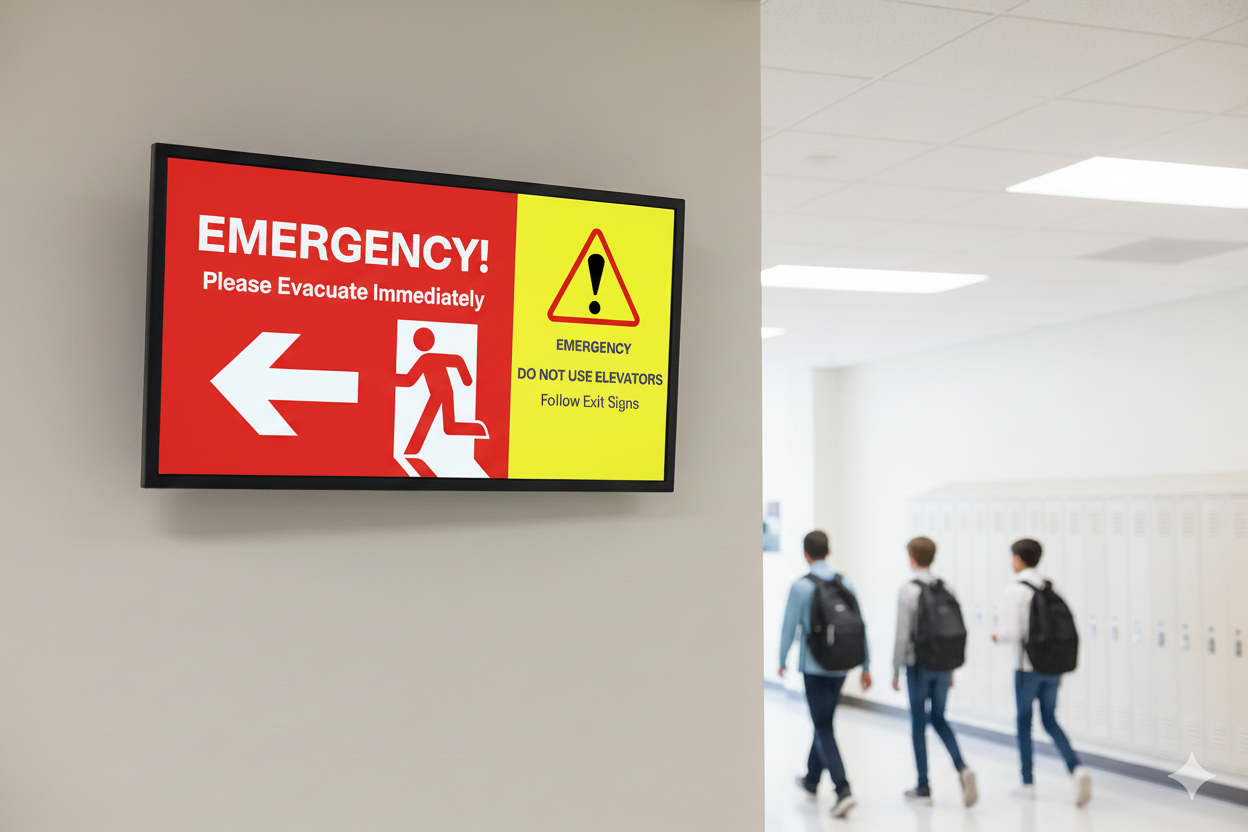
Digital signage, voice alarm systems, voice evacuation systems and integrated public address systems form the emergency communication system that fulfils Martyn's Law duties — real-time communication, public guidance and incident response coordination.
In high-risk scenarios, the speed of communication can save lives. Integrated with emergency alert systems, digital signage networks can be instantly overridden to display urgent messages such as evacuation instructions, assembly point directions, or threat notifications.
These dynamic displays are far more effective than static signage, enabling rapid dissemination of accurate, location-specific information.
During both everyday operations and emergency events, digital signage supports effective crowd control. Strategically placed screens and kiosks can display tailored content based on live footfall data or real-time instructions from a control room.
This ensures orderly flow of people, reduces congestion, and mitigates panic in time-critical situations.
A key aspect of Martyn's Law is ensuring that staff are trained and that the public is informed. Digital signage enables ongoing safety messaging through pre-scheduled content—such as safety tips, what-to-do infographics, and emergency protocol videos.
This reinforces preparedness in a visually engaging and accessible format.
Digital signage becomes even more powerful when integrated with broader AV infrastructure, including CCTV, access control, and PA systems.
This creates a seamless central command ecosystem, allowing security personnel to push messages to screens based on insights from surveillance feeds or access points.
AV solutions can support accessibility by delivering multi-language messaging and visual cues for individuals with hearing impairments.
Compliance with Martyn's Law requires a focus on inclusivity—and signage can play a key role in meeting these expectations.
Clear, reliable audio systems for directing people to safer areas, providing instructions and maintaining communication during emergencies.
Integrated PA systems work seamlessly with digital signage to provide both visual and auditory guidance during critical incidents.
Digital signage is only one component of a comprehensive AV strategy. At Strive AV, we work with clients to design integrated safety ecosystems—combining LED display solutions, digital displays, public address systems, and sensor-based analytics to create smart, secure environments.
Discuss Your Martyn's Law Requirements →(Examples, not exhaustive. Scope ultimately depends on use and expected numbers.)
Council Buildings
Educational Institutions
NHS Locations
Places of Religious Worship
Retail Outlets
Stadiums & Event Venues
Transport Hubs
Entertainment Venues
Updated May 2026
3 April 2025
The Act received Royal Assent and became law.
15 April 2026
Home Office published the Section 27 statutory guidance — 129 pages plus three supplementary papers. HTML accessible versions added 27 April 2026.
Closes 12 June 2026
SIA is consulting on its draft enforcement guidance. Particularly relevant if you deploy mass communication or integrated control platforms.
Spring 2027 (likely April 2027)
Government, the SIA and most legal commentators are now consistently signalling Spring 2027, subject to formal Parliamentary confirmation.
Sources: Home Office (Section 27 statutory guidance, gov.uk), SIA (Section 12 consultation), ProtectUK.
Document your expected numbers (including staff) and whether you reach 200+ or 800+ from time to time, then assess vulnerabilities at each site.
For enhanced tier, also identify your designated senior individual — they carry personal liability that cannot be delegated.
ACT (Action Counters Terrorism) Awareness Training is the recognised baseline for Martyn's Law preparedness — free, government-backed, delivered through ProtectUK.
Create procedures for evacuation, invacuation, lockdown and communication (EILC) and brief/train staff appropriately.
Prepare to notify the SIA and keep records to demonstrate compliance once the Act commences. For enhanced tier, also draft your narrative compliance document.
Assess your public address system, voice alarm and voice evacuation coverage, and digital signage emergency-override capability — invest where rapid response would be slowed today.
Source: GOV.UK
With over 20 years of experience delivering intelligent AV solutions to public and private sector clients, we understand the unique requirements of safety-driven environments. Our integrated approach combines digital signage, public address systems, and security infrastructure to create comprehensive safety ecosystems.
As Martyn's Law moves closer to implementation, it's essential that venues act now to audit their spaces, assess communication channels, and invest in technologies that support rapid response and risk mitigation.
Masscoms is Strive AV's specialist partner for Martyn's Law compliance. Their Martyn's Law-ready emergency response system pairs with our public address, digital signage and occupancy analytics so your venue's protective duty is covered end to end.
Combined response and visitor-communication coverage, deployed and supported by a single integration team.
Visit Masscoms











Explore related insights and guides
Speak to our design team today to discuss your next AV project. We'll guide you through every step - from consultation to completion.
Our industry certifications and accreditations